
Celebrating Hanal Pixan: What You Need to Know About Day of the Dead in Merida



Wondering, What is the Meaning of Hanal Pixan?
Hanal Pixan (pronounced ha-nawl peesh-awn) translates to “food for the souls” in the Maya language.
It is a Mayan holiday celebrated throughout Mexico’s Yucatan Peninsula, and is sometimes called Mayan Day of the Dead.
Both Hanal Pixan and Día de Muertos (Day of the Dead) are celebrated on November 1-November 2. The holidays actually have many similarities, but also some differences — which you’ll discover in this article.
While it has ancient origins, many Yucatecan people still celebrate Hanal Pixan today, and children even learn about the holiday in local schools.
There are numerous activities during the three-day festival that hold different meanings, which will be covered below.
In Merida, the Cultural Capital of the Yucatan, expect celebrations, city-wide festivals, special foods and local customs.
Ready to discover the history of Hanal Pixan, and how to celebrate Hanal Pixan in Merida, Mexico today? Let’s get to it!
What is Hanal Pixan?
Much like Day of the Dead, these are two of the most important Mexican holidays — though Hanal Pixan is celebrated only in Yucatan, whereas Day of the Dead is celebrated throughout Mexico.

The Maya believe the pixan (pronounced peesh-awn, and meaning “soul”) is what forms human life.
They say once the body dies, the soul remains, so that the pixanes (plural of pixan and meaning “souls”) and the living are always connected on some level.
On certain occasions, like Hanal Pixan, the soul can fully cross back Earthside for the holiday.
During Hanal Pixan (sometimes spelled Janal Pixán and sometimes called the Mayan Night of Souls), families honor their loved ones who have passed.
They set up altars filled with their favorite food and symbolic items to help guide the deceased home. Hanal Pixan is meant to continue the link between the dead and the living.
Origins of Hanal Pixan & Day of the Dead

The holiday’s origins date back to the Aztec celebration of the goddess Mictecacihuatl, their Queen of the Underworld.
Much like the current incarnation of the Day of the Dead, the Aztec festival was a celebratory affair.
After Mexican colonization by the Spanish, who brought with them Christianity, the day of the dead festival was moved from early summer to fall.
Its new dates coincided with what Christians called Allhallowtide, another multi-day holiday commemorating the deceased.
Allhallowtide took place on October 31-November 2. The first day, October 31, was known as All Saints’ Eve; November 1 was All Saints’ Day; and November 2 was All Souls’ Day.
This is a Celebration of Life; Not Death
Unlike many present-day rituals around death, the Hanal Pixan holiday is not a somber funerary event.
On the contrary, Hanal Pixan is a celebration, one so grand even the deceased return to attend the party held in their honor.
When is Hanal Pixan?
Actual celebration dates can vary, but traditionally, Hanal Pixan is celebrated for three days straight — beginning on the night of October 31st, and ending on November 2nd.

💀 Hanal Pixan: Three Days Festival
The first night is meant to honor the children that have passed. November 1st pays homage to adults who have passed, while the final day, November 2nd, is dedicated to everyone who passed.
Throughout the three-day festival from October 31-November 2, different altars are constructed and various celebrations happen.
You can observe the differences in the altars each night, as they are dedicated to different loved ones.
October 31: All Saints Eve
Many families observe October 31, the former All Saints’ Eve, by building an elaborate ofrenda (altar) on the cemetery gravestone of their deceased loved one.
As this is the eve of the souls returning, these preparations must be ready for the spirits’ arrival at midnight.
In the Maya language, this day is called U Hanal Palal.
November 1: Day of the Little Angels

What was formerly known as All Saints’ Day, is present-day Día de los Angelitos, or Day of the Little Angels. In the Maya language, this day is called U Hanal Nucuch Uinicoob.
This day is said to honor the children who have passed. The spirits of the angelitos (angel children) returned the night before, at midnight, but parties continue all day.
You may also see this day called the Día de los Inocentes, or Day of the Innocents November 1.
However, make sure not to confuse it with Day of Holy Innocents, which is on December 28th, and one of the most unique Mexican holidays.
November 2: Day of the Dead
Formerly known as All Souls’ Day, November 2 is the actual Day of the Dead day. In the Maya language, this day is called U Hanal Pixanoob.
On this day, families and loved ones celebrate the adults in their life who no longer walk the Earth. The spirits of all adults returned the night before, at midnight, but festivities often continue all day.
Hanal Pixan vs Day of the Dead: The Differences

You may be wondering, Is Hanal Pixan the same thing as Día de los Muertos?
While they share similarities and are celebrated on the same dates, locally, they are not considered the same thing. It’s easy to think of Hanal Pixan as the Mayan version of Day of the Dead.
While Dia de Muertos is largely celebrated throughout South and Central Mexico, not everyone in Mexico celebrates it.
In regions that do, like Mexico City, Oaxaca City, San Andrés Mixquic, Morelia, and Pátzcuaro Michoacan (especially Janitzio Island on Lake Pátzcuaro), local traditions may vary within cities and families.
Hanal Pixan, however, is only celebrated in the Yucatan Peninsula, and comes from the Mayan people. Most Yucatecans still celebrate the holiday today.
Hanal Pixan Altars vs Day of the Dead Altars

Both holidays involve setting up ofrendas (altars) to allow the dead to pass over and celebrate with their loved ones.
However, while they share some similarities in what’s included on those altars, Hanal Pixan has different traditional items.
During Hanal Pixan, families aren’t allowed to put photos of their deceased loved ones on the altar until a year has passed since their death.
You also cannot touch the food that’s placed on the altar until the day after and they change the altars according to which day it is.
Día de Muertos and Hanal Pixan both have different meanings on different days, but they aren’t the same.
The food that is eaten throughout the holiday also differs during Hanal Pixan. Here you’ll find traditional Mayan dishes of the region that you won’t normally see in Día de Muertos celebrations.
Hanal Pixan in Merida Yucatan

One of the most popular places to celebrate Hanal Pixan, and home to the biggest festivities, is Merida.
Merida is the capital of Yucatan, which makes it an easy place to visit if you want to join in on Hanal Pixan celebrations.
How is Dia de los Muertos celebrated in Merida?
In Merida, the city will be decorated for Hanal Pixan. You’ll find altars throughout the town, but some of the best ones are in Plaza Grande (Main Plaza in Downtown Merida) and other public spaces.
You’ll find vendors selling goods at Mercado Lucas de Galvez Market, the largest market in Merida.
If you want to make a Hanal Pixan altar, this is the best place to go to find what you need to create your altar.
There will be some celebrations leading up to the holiday in Merida, but families are mostly preparing altars and their loved ones’ tombs beforehand.
During the three days of Hanal Pixan in Merida, there will be different public festivities day and night.
The two biggest traditions in Merida are the Camino de Flores (Road of Flowers or Flower Path) and Paseo de las Animas (Parade of Souls). You’ll find more info about both just below.
Best Hanal Pixan Merida Events
In 2026, Mérida’s Festival de las Ánimas runs October 24 to November 2, with free events across the city.
1. Paseo de las Animas (Merida Day of the Dead Parade)

Paseo de las Animas is one of the most popular events in Merida. It’s usually held in the last days of October; in 2026, it’s Friday, October 30. (See the 2026 dates below.)
During the parade, you’ll hear music and see thousands of people dressed up in traditional attire with their faces painted as skulls.
If you’re interested in participating, this is a wonderful way to do so. Face painters will be set up before the parade, so you can easily get your face painted and join in.
📆 2026 Merida Day of the Dead Parade info
In 2026, the parade will take place Friday, October 30, from 6pm to 11pm.
The Merida Hanal Pixan Parade starts at the Cementerio General de Mérida (Main Merida Cemetery), and the parade ends at Parque San Juan Park, where the festivities continue.
You can see the entire parade route with this map.
2. Camino de Flores (Path of Flowers)

Camino de Flores, which loosely translates to Road of Flowers, features beautiful displays of more than 30,000 plants and flowers (some sources say 60,000 flowers 🌼).
The displays are all made with the Hanal Pixan or Day of the Dead theme in mind. This is a wonderful place to walk around during Hanal Pixan in Merida.
3. Monumental Altar in Plaza Grande

Don’t miss the largest public altar in Merida, which is huge.
Located in Plaza Grande (Main Plaza), just across from the Merida Cathedral, the Altar Monumental (more than 14 meters tall) goes on display in the Plaza Grande on October 25, 2026, at 6 pm, with guided explanations of its meaning on November 1 and 2 at 10 am.
This large ofrenda in Merida honors deceased public authorities and also some prominent members the general public.
4. La Catrina Parade (Second Biggest Merida Hanal Pixan Parade)

Similar to the Mexico Day of the Dead parade, Merida also holds a smaller-scale parade to honor La Catrina. This is the skeletal woman who has become an icon of the holiday.
The Mérida La Catrina Parade takes place Saturday, October 31, 2026, at 8 pm, starting at the Plaza Grande and traveling along Paseo de Montejo to Parque La Plancha. To get a good spot, plan to arrive by 7pm.
If you want to have your own La Catrina face painting done (or El Catrin for the men), arrive early and visit the face-painters that will be set up along the Paseo de Montejo. You can expect to pay about $50-100 MXN pesos ($3-8 USD).
The parade ends at Parque La Plancha.
5. Merida Parade of Alebrijes

Alebrijes are fantastical creatures, which some say serve as spirit guides to the underworld.
While they don’t have ancient ties to the Hanal Pixan or Day of the Dead holidays, they are part of many present-day celebrations.
In Merida, local families, businesses, schools and organizations participate in the Parade of the Alebrijes.
During this, they parade their large, hand-crafted alebrije sculptures through downtown and along Paseo Montejo.
For more info on the Merida Day of the Dead parade and other local events, check the Merida government website here.
Hanal Pixan in Pomuch, Campeche

Curious about other Day of the Dead Yucatan celebrations?
One particularly unique Hanal Pixan tradition happens in Pomuch, a small town in Campeche state, which is only a few hours from Merida by rental car.
🚙💨 Want to visit Pomuch, Campeche? Check out this Merida to Campeche Travel Guide for more info on travel between Yucatan state and Campeche state.
During Day of the Dead in Pomuch, people clean the bones of their loved ones, which is an ancient Mayan tradition. This is how they pay homage to their deceased family and friends.
Once a person has been dead for three years, they keep their bones in a wooden box and clean them each year during Hanal Pixan.
If they don’t, it’s believed that the spirits will be angry and act out on the streets.
You can observe this tradition taking place at the Cementerio de Pomuch, Pomuch Cemetery in Campeche.
Families start by cleaning the small bones and then move to the skull. Throughout the ritual, they’ll be praying, and talking to their loved ones.
💀 Day of Skulls in Bolivia
The Aymara people in the Bolivian Andes have a similar tradition called Day of Skulls.
On November 8, they take their loved ones’ skulls, which are often adorned in decorations, to the cemetery.
The skulls are called ñatitas, and you can ask them to grant wishes for the coming year.
🪁 Kite Festival in Guatemala
The town of Sumpango, Guatemala, also hosts a unique Day of the Dead celebration called the Festival de Barriletas Gigantes (Giant Kite Festival).
On November 1, local people fly giant, colorful kites above the town’s cemeteries.
Traditional Symbols of Hanal Pixan

1. Hanal Pixan Altars
Just walking the streets of Merida, you’ll see ofrendas (altars) throughout town, inside shops and restaurants.
They are all decorated with marigold flowers, candles, copal incense and papel picado colorful paper flags.
You’ll also see photos of their loved ones and whatever food and drink they would want to consume on their arrival.
They say when the dead return they will be hungry and thirsty from the journey, so we have to prepare accordingly.
2. Marigold Flowers (Cempasuchil)

The marigold flower, or cempasuchil (pronounced sem-pah-souch-ill), has been a part of this celebration dating back to its Mayan origins.
Throughout Mexico, marigolds are often called flor de los muertos (flowers of the dead) because of their associations with the Day of the Dead holiday.
According to pre-hispanic beliefs, the flower’s bright color and strong scent served a sensory guide for the spirits.
They believed the marigold flowers let our departed know exactly where they should return to meet us.
Nowadays, no Hanal Pixan ofrenda (altar) is complete without some cempasuchil flowers and coxcomb flowers on it.
You’ll also see them all over Merida and other places in Yucatan — on restaurant tables and as elaborate floral archways outside shops.
3. Hanal Pixan Sugar Skulls

One of the icons of this holiday is the Hanal Pixan festival sugar skull. Ironically enough, these confectionery treats don’t really have Mexican (or even pre-Hispanic) roots, and come from Europe.
Italian Catholic missionaries brought sugar art to Mexico in the 1600s.
Unlike Europe, Mexico is abundant in sugar and sugarcane, so it became a natural place for these molded sugar figures to take root and form their own traditions.
SMALL VS LARGE SUGAR SKULLS
During Hanal Pixan and Day of the Dead in Mexico, sugar skulls will be made in two sizes.
The larger ones are often placed on a gravestone in honor and remembrance of the departed children.
These bite-sized ones can also be eaten, used for in-home ofrenda (altar) decoration, and can be taken home as souvenirs.
The larger ones represent a departed person, and that person’s name is written on the forehead of the skull.
You’ll usually see these more elaborate, larger sugar skulls placed on an ofrenda or gravestone for that person’s returning spirit. These are not meant to be eaten.
💀 Amaranto SKULLS
You might also see Hanal Pixan skulls in Merida made of amaranto (amaranth grain).
This is a popular food eaten all over Mexico all year-long, but during Hanal Pixan, you’ll find it fashioned into amaranth skulls.
4. Hanal Pixan Cemeteries

Cemeteries during Hanal Pixan are a sight to see. Families spend days preparing the tombs of their loved ones before Hanal Pixan.
They’ll paint graves, set up candles, create elaborate altars and make gorgeous flower arrangements.
During Hanal Pixan, cemeteries become a gathering place. Families visit their loved ones and share drinks and food and talk to the deceased.
If you’re celebrating Hanal Pixan, visiting a cemetery is a must.
5. La Catrina: The Skeleton Woman

Besides Frida Kahlo, La Catrina might be the woman most commonly associated with Mexico.
This elegant skeletal lady, who everyone paints their faces to look like, was born in 1910 when Mexican printmaker/illustrator Jose Guadalupe Posada first drew her.
He named this figure, La Calavera Garbancera (The Elegant Skull), and she was drawn as satirical social commentary.
His dapper woman with her fancy feathered-hat was a critique of Mexican society at the time, when many Mexicans were aspiring to dress and act more European.
Posada saw this as a snub to the more humble, and traditional style of Mexican dress.
He created his Calavera Garbancera character as a skeleton who would serve as a reminder that we all eventually die one day — whether we’re wearing fancy clothing or not.
🖼 History of La Catrina, Day of the Dead Icon

La Catrina’s transition into the official grand dame of Day of the Dead came after Mexican artist Diego Rivera (AKA Frida’s husband) painted her with a full-body and Victorian dress.
Using a similar face, he took Posada’s La Calavera Garbancera image and created who would become known as La Catrina.
Rivera’s 50-foot-long painting (15 m), Sueño de una tarde dominical en la Alameda Central (Dream of a Sunday afternoon in the Alameda Central), seen above, is the first-ever depiction of La Catrina.
She is placed in the dead center of the painting (pun intended), with Rivera himself by her side, and Frida Kahlo behind them.
🎨 Want to see the painting in real life? You’ll need to head to Downtown Mexico City, to the Diego Rivera Mural Museum, one of the best museums in Mexico City.
Traditional Food in Hanal Pixan
Pib (Pibipollo or Mucbipollo)

If you’re traveling to Yucatan during Hanal Pixan, the Mayan Day of the Dead holiday, don’t pass up the chance to try pib (AKA mucbipollo).
One of the most important Day of the Dead foods in the Yucatan Peninsula, Pib is a crispy, baked tamale. Cooked in large sheets, it almost looks more like a casserole than a Mexican tamal.
⚠️ Yucatan Foods Tips: For Yucatan visitors, you’ll probably just want a single pib tamal, not a whole pan of it!
If so, be on the lookout for a single serving of pib tamale, which is called chachacuahs or tamales enterrados, meaning “buried tamales.”
Yucatecan pib is a locals’ favorite — and something you’ll rarely (if ever) see outside of Yucatan Peninsula.
It is only made and sold from about mid-October to early-November to coincide with the Hanal Pixan holiday.
In fact, there’s even a Merida Pib Festival (or, Merida Mucbipollo Festival) held each year in October.
Pan de Muerto

Pan de muerto (or, bread of the dead) is a type of pastry bread that’s traditionally only made from about mid-September to mid-November for Day of the Dead Mexico.
This is a unique pastry, but is sort of a hot cross bun meets a morning bun.
Like a morning bun, the dough contains orange zest or orange blossom water, for a lovely, mild citrus flavor.
Similar to a hot cross bun, the dough of the pan de muerto has a cross shape on the top of the roll, and it’s topped with sugar.
To sample some, head to a local panaderia (bakery) in Merida. Even many of the best restaurants in Merida will serve a special pan de muerto dessert during the holiday.
Xek Salad

Xek (sometimes spelled Xec) means “scrambled” or “jumbled” in the Maya language.
It is a salad made with a lot of citrus fruits, including orange, tangerine and grapefruit, and also jicama, which is a favorite veggie throughout Mexico.
The salad is bathed in juice from the naranja agria, which means sour orange. Similar to the Seville orange, naranja agria is an orange from the Yucatan Peninsula that’s used throughout traditional Yucatan food.
The whole mixture is topped with piquín chili powder, cilantro, and salt.
Traditional Drinks in Hanal Pixan

Xtabentun Honey Liquor
Xtabentun (pronounced shtab-en-tune) is an ancient Mayan liquor that’s been made for thousands of years.
It consists of anise seed and honey made by bees that collect the nectar of xtabentún flowers. Rum is added to the mixture, and it all ferments to create smooth, sweet xtabentun.
To drink, many locals have it straight up or poured over ice. Some people add it to their coffee or even make a Mayan Coffee.
This drink is made with coffee, a shot Kahlua, a shot of xtabentun and heavy cream or ice cream.
When traveling to Merida, a bottle of xtabentun makes one of the best Yucatan souvenirs to bring home.
Balche
Balché (pronounced bah-lah-chay) is a mildly intoxicating beverage consumed by the Maya in the Yucatan Peninsula and the Lacandon Jungle area in Chiapas state.
It is a fermented drink that’s made using the bark of the evergreen Balché tree (Lonchocarpus violaceus), cinnamon, anise and local Mayan honey.
Atole

Atole (pronounced ah-toe-lay) is one of the most common Mexico street drinks, especially popular during the Day of the Dead and Las Posadas at Christmastime.
It is a corn-based beverage with a yummy mix of cinnamon, masa, piloncillo (unrefined cane sugar) and vanilla.
Atole (also sometimes spelled atolli, and sometimes called atol de elote) is near-identical to champurrado.
This is another one of the best traditional Mexican drinks but made with chocolate inside of vanilla, which atole has.
Tanchucuá
Tanchucuá (pronounced tan-choo-cha) is a traditional Mayan drink made with ground chocolate and masa (corn dough), but may also contain anise.
It is very thick in texture and pairs well with pib or tamales.
Tanchucuá is consumed in the Yucatan Peninsula and its neighboring Tabasco state. You might also see it called atole de tanchucuá.
Hanal Pixán: Frequently Asked Questions
What is the meaning of Hanal Pixan?
Hanal Pixan (pronounced hah-nal peesh-awn) translates to food for the souls in the Maya language. The word hanal means “food,” and pixan means “soul.”

Did Mayans celebrate Dia de los Muertos?
Yes — Hanal Pixan (Mayan Day of the Dead) and Mexican Day of the Dead both have pre-hispanic roots, and both the ancient Maya and Aztec people have celebrated multi-day holidays to honor the deceased.
Who celebrates Hanal Pixán?
Today, you’ll find Hanal Pixan celebrated throughout the Yucatan by most local people. Visitors are welcome to join in public celebrations, as long as you’re respectful.

What do I wear for Hanal Pixan?
Since it’s Hanal Pixan, you might want to pack a special dress or outfit (or both) to enjoy the nighttime festivities.
Costumes are the norm for locals, and many do go all out with traditional Mayan huipil garments and face painting (though that is not traditional).
You can head to a local Merida mercado (market), like Mercado Santa Ana and Mercado Lucas de Galvez, for yours.
🙈 What NOT to wear for Hanal Pixan in Merida
This is not the place for American-style costumes, especially the “sexy costumes” and overly skimpy outfits that always end up on Buzzfeed lists.
Check out the options above for an idea of what you might wear, and you can click on any image to shop for Day of the Dead attire.
💄 Day of the Dead Make-Up & Flower Crowns
You don’t need to bring all your makeup for La Catrina face painting, as you can just pay someone about $50-100 pesos (about $3-8 USD) on the street to do it.
You, however, will want to bring a good makeup remover.
You’ll also find vendors selling inexpensive flower crowns to complete the look — or you can go all out with one of 🌸 these elaborate flower crown headbands.
You can also try your luck at one of the Merida mercados mentioned above, as you’ll sometimes find vendors selling fresh flower crowns.
Merida Mexico Travel Guide & FAQ
Where to stay in Merida for Hanal Pixan
The vast majority of visitors will want to stay in Centro Historico (Downtown Merida), especially if you aren’t renting a car in Merida, because downtown is walkable.
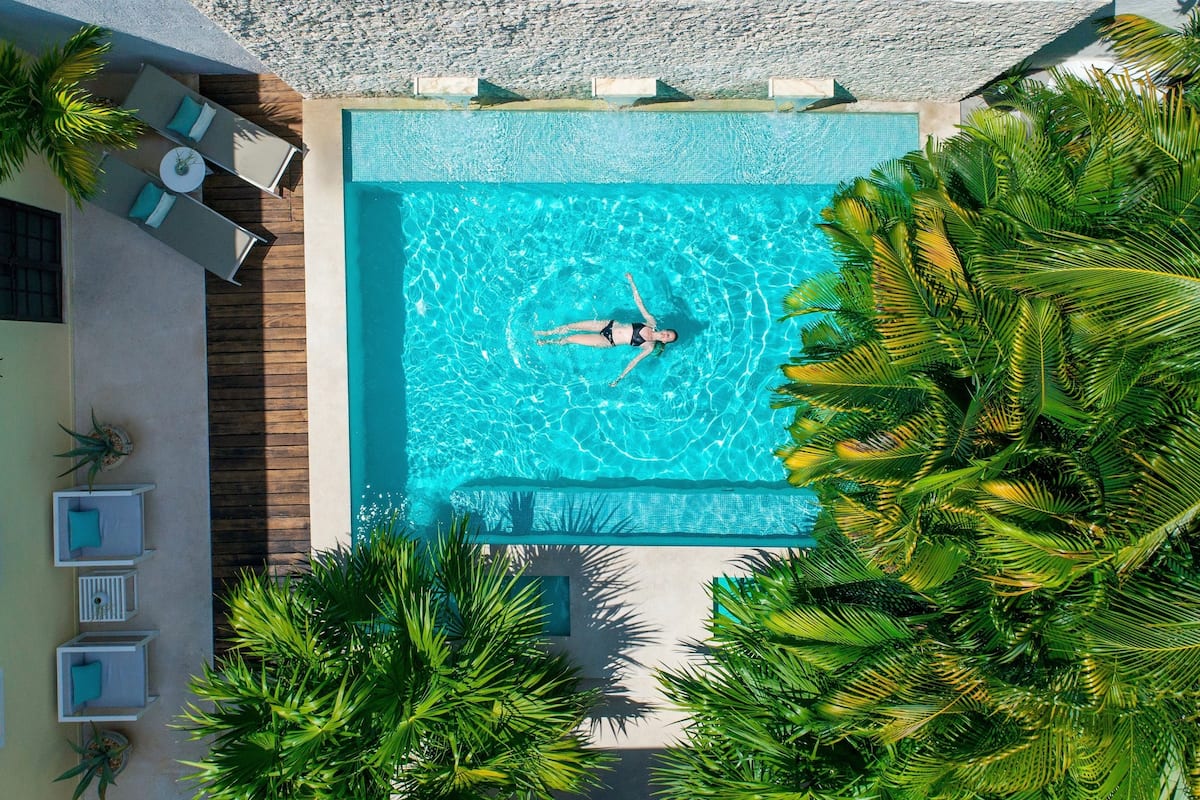
Check out the guides below, which highlight all the best Merida accommodations:
- Best Merida Hotels
- Best Merida Boutique Hotels
- Best Merida Airbnbs & VRBOs
- Best Merida Hacienda Hotels
- Best Hotels in Merida
Flights to Merida, Mexico

✈️ Best Merida Airport transfers
Here are the top-rated Merida airport transfers on Viator:
- Mérida International Airport (MID) to Merida hotels – Arrival Private Transfer
- Mérida International Airport (MID) to Merida hotels – Roundtrip Private Transfer
Final Thoughts: Celebrating Hanal Pixan in Yucatan

Hanal Pixan in Merida attracts large groups of tourists each year. However, it’s important to remember that this is a holy, traditional holiday for the Mayans and Yucatecans.
Hanal Pixan is an incredible holiday to experience, but if you want to participate, please be respectful.
This includes abiding by local traditions and rules and educating yourself on the history and meaning.
While this article was a good starting point, there are others, like this one in The Yucatan Times that will also help you understand the Mayan Hanal Pixan holiday and Dia de los Muertos Merida Mexico.